

In the below note, we’ll discuss the reasons why we view ServiceNow Inc (‘NOW’) as an exceptional business.
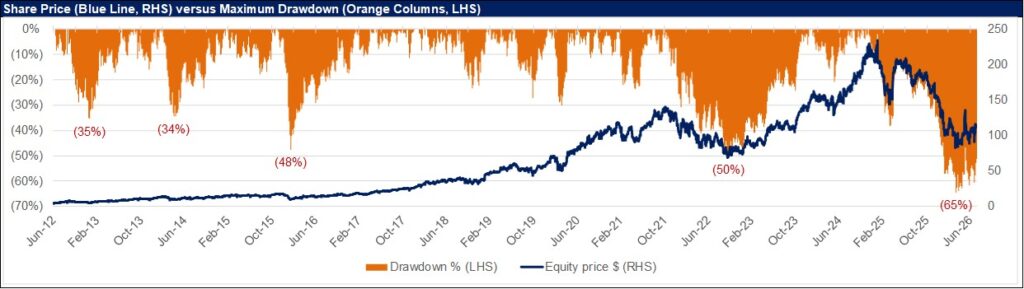
Since listing on the NYSE in June 2012, ServiceNow’s equity has delivered a split-adjusted compound annual return of 25%. $1 purchased at IPO is worth roughly $23 over 14-years later.
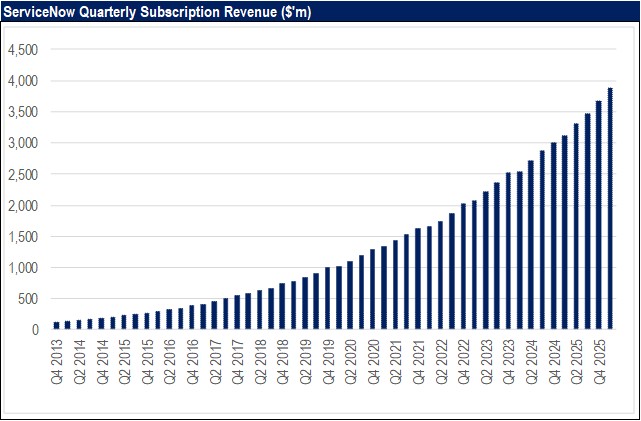
Over the same period, sales have compounded at 36% p.a., from $244m in 2012 to $13.3b in 2025.
THE WORKFLOW BUSINESS
ServiceNow sells cloud software that automates the routine workflow between a company’s departments – IT requests, HR queries, customer service cases, security incidents. It does this all on a single platform.
A workflow is simply a business process with multiple steps & multiple hands. It might involve onboarding a new employee, resetting a password or resolving a customer complaint.
At a small company, the need for automated workflows, and the value gained from them, is comparatively low. At a large company with over 1,000 employees & a much higher level of complexity, fragmentation & technical debt, workflow automation can add considerable value. It allows for previously laborious and slow-moving tasks, often requiring inter-departmental communication, to be completed in a much more efficient manner.
Most large companies run their processes across dozens of disconnected systems, stitched together by email, spreadsheets and numerous applications.
ServiceNow sits one layer above those systems and moves the work between them. Onboarding a single employee at a large organization can require updates to c.20 separate systems. ServiceNow completes the process in less than a day, with every step logged and approved by the appropriate individuals.
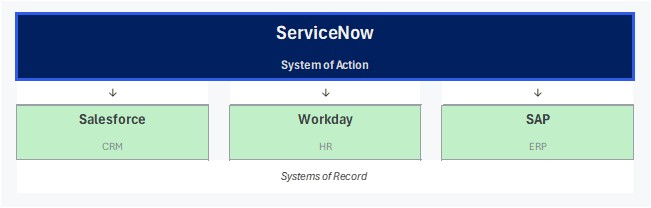
ServiceNow currently serves over 8,800 customers, including more than 85% of the Fortune 500.
The company began in IT service management (‘ITSM’) and IT operations management (‘ITOM’), categorized under Technology Workflows. Market share in this segment has grown from 7% in 2011 to close to 40% in 2025.
Employing a classic land-and-expand model, over 85% of new business each year comes from existing customers. Once a customer is onboarded – typically starting with the core ITSM – they consistently expand their spending by adopting new workflows (HR/CRM), adding seats, & upgrading to premium tiers. The Annual Contract Value (‘ACV’) per cohort of customer has compounded at a high rate.
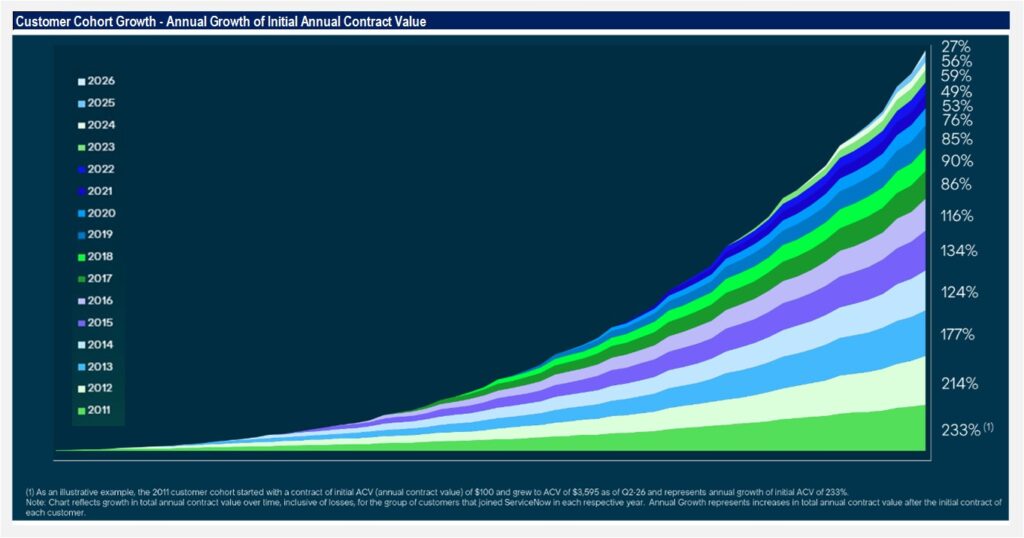
The horizontal expansion increases a customer’s reliance on the platform, actively reducing the probability of them leaving.
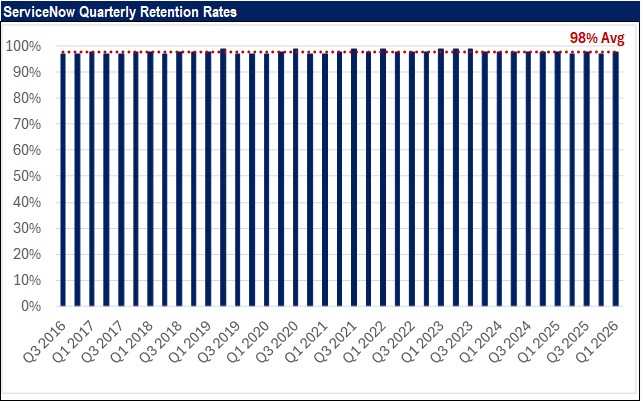
ServiceNow exhibits best-in-class retention metrics with renewal rates consistently around 97-99%, a function of the high switching costs.
COMPETITIVE ADVANTAGE
Switching Costs
The best-in-class renewal rate reflects exceptionally high switching costs as the ServiceNow platform runs mission-critical IT and enterprise workflows that touch nearly every department. Replacing ServiceNow means costly, year-plus implementations, employee retraining, and running two systems in parallel.
ServiceNow’s Configuration Management Database (CMDB) maps every hardware asset, software application, cloud resource, and their operational interdependencies across the enterprise. It is built upon decades of workflow history. Migrating away from ServiceNow isn’t just swapping software; it requires rewiring the operational processes of thousands of employees across IT, HR, and customer service.
Single Unified Structure
The Now Platform is a single, unified architecture upon which all of the company’s products are built — spanning IT, HR, customer service, security, and creator workflows.
Rather than offering a collection of siloed point solutions, every product shares a common data model, codebase, and architecture, enabling seamless interoperability across the enterprise. This makes ServiceNow’s offering incredibly attractive to large enterprises that want both breadth and long-term structural simplicity.
THE AI DISRUPTION RISK
Over the past 18 months, market concerns have centred around the idea that Artificial Intelligence models will disrupt the likes of ServiceNow and its cloud-based software model. ServiceNow, alongside other well-known software businesses, has seen its share price decline significantly.
- Code Commoditization
A current fear is that AI-native start-ups and/or large enterprise customers themselves will be able to easily recreate & replace ServiceNow’s offering. This often gets referred to as ‘vibe-coding’.
The theory is that AI reduces the cost of writing & developing software to near-zero which destroys any technical barrier to entry. Customers will then be inclined to vibe-code their own in-house solutions or find a much cheaper alternative.
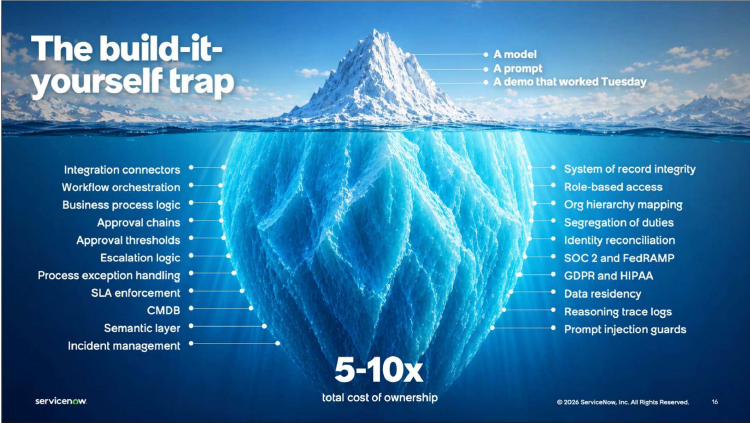
This is a plausible threat, however, in the context of ServiceNow, this disruption thesis ignores real-world friction & assumes that the code is the moat.
In reality, ServiceNow’s durable value extends well beyond its underlying code. Code is only one part of what makes enterprise software valuable.
While AI dramatically lowers the barrier to creating basic applications, it does not solve the immense complexity of running them securely at large enterprises. The idea of a custom vibe-coded solution ignores the maintenance, data structure, dependency, governance and security requirements of large organizations.
If the barrier to competition was purely code based wouldn’t someone have already challenged ServiceNow’s dominance in this space? Writing code is certainly easier now but it wasn’t impossible previously. It seems naïve to think there isn’t more to it.
2. The End of Seat-Based Pricing
SaaS models have historically monetized on a per seat basis whereby each user pays a subscription to access the platform.
The risk is that autonomous AI agents are so effective that they replace human workers. Autonomous agents can be seen as digital workers that do not require human intervention to complete tasks. Fewer workers lead to fewer licenses and less revenue under the incumbent model. The demand for knowledge workers, ServiceNow’s primary user base, could structurally decline as generative AI scales.
At present there has been limited evidence of any seat-based erosion. Management has explicitly stated that active seats are actually going up and their total addressable user base continues to grow. They have also pointed to a customer preference for traditional seat-based licensing where the alternative, charging on a per token[1] or consumption basis, can introduce significant budget volatility. For now, many customers prefer the predictability of a per seat model.
ServiceNow has also evolved its commercial model to mitigate the risk of autonomous agents replacing human seats. The company has introduced a hybrid pricing structure that combines predictable base seat licenses with usage-based meters for AI assists. By decoupling revenue from human headcount, 50% of ServiceNow’s net new business is already derived from non-seat-based pricing, including tokens, infrastructure, and hardware.
ServiceNow’s hybrid pricing model is a deliberate attempt to align its own revenue growth with demonstrable customer outcomes, moving beyond simple seat-based licensing toward a structure where both parties benefit as AI usage scales.
THE AGENTIC ERA OPPORTUNITY
Agentic AI marks a shift from reactive chatbots to proactive digital workers. Instead of merely answering questions, agentic systems act like project managers: they receive a goal, break it down into sub-tasks, select the right tools, execute steps independently, and course-correct when hitting roadblocks.
Gartner projects that approximately 40% of enterprise applications will integrate task-specific AI agents by the end of 2026, up from less than 5% in 2025.
While the broader agentic landscape is still early and evolving, ServiceNow is actively embedding autonomous agents and agentic workflows directly into its Now Platform to automate complex, multi-system enterprise processes.
The majority of enterprises are still in early or mid-stage adoption, constrained primarily by data readiness and governance maturity rather than model capability. ServiceNow aims to lift those constraints.
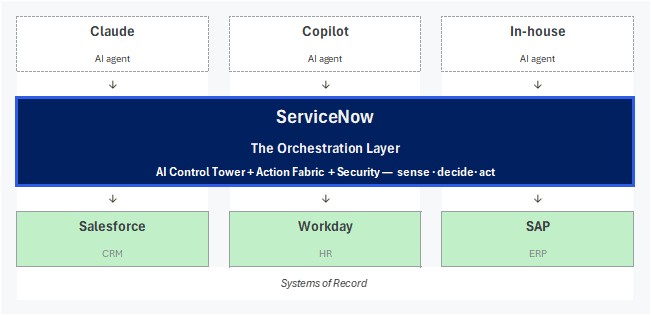
ServiceNow is positioning itself as the orchestration platform for Agentic AI. Successful execution here could turn the market’s perception of AI as a disruptive threat on its head and provide a significant tailwind for ServiceNow’s growth.
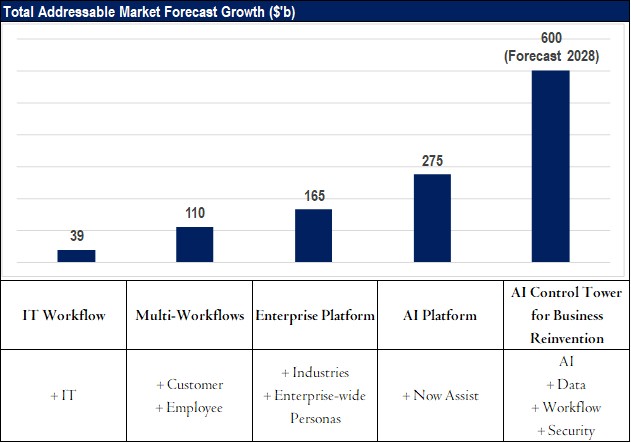
AI allows ServiceNow to target the massive labour budget rather than just the software budget. It provides the company with a much larger market to address.
ServiceNow’s core offering has already mapped the core workflows of its customer base, placing it in a powerful position to be able to integrate agents.
ServiceNow has embedded agentic AI into all of its workflow products: AI Control Tower, AI Agent Studio, AI Agent Fabric, Level 1 Support AI Specialist, ServiceNow Otto.
Successful execution on ServiceNow’s usage-based pricing strategy combined with significant enterprise adoption of AI could see ServiceNow positioned as an effective toll-road for enterprise compute. In this instance, revenue would be directly tied to the customer’s productivity gains rather than arbitrary headcount limitations. These are the types of win-win situations we seek.
STRATEGIC ACQUISITIONS
ServiceNow has historically favoured organic growth and internal product development. A recent uptick in M&A activity has led to some fears that the company is buying growth and abandoning its organic growth strategy.
Management has consistently framed M&A as complementary to organic growth rather than a substitute for it. The recent inorganic strategy centres on acquiring technology & talent to accelerate the product roadmap & expand its total addressable market, not to buy revenue.
Recent acquisitions represent a deliberate, strategic effort to build out an AI-native execution platform.
Moveworks serves as the conversational front door, allowing employees to direct complex AI workflows simply by chatting in plain English.
Veza acts as the identity boundary layer, ensuring autonomous AI agents only access the specific data and systems they have explicit permission to touch.
Armis provides real-time visibility into every connected asset — IT, OT and IoT — and the cyber exposure attached to each, extending the CMDB’s map of the enterprise to everything an AI agent might act upon..
Put together, the logic is clear: Moveworks is how you talk to the agents, Veza controls what they’re allowed to touch, and Armis shows them everything they’re working with.
FUNDAMENTALS
Over the past ten-years, ServiceNow has achieved a top line compound annual growth rate of 29%.
Under GAAP reporting the company is currently delivering 78-79% gross margins, up from 67% ten-years ago. GAAP operating margins have climbed to 14% having reached breakeven in 2019.
ServiceNow’s business is highly cash generative supported by a capital light model and negative working capital because customers typically pay for subscriptions upfront.
The company runs a conservative balance sheet and typically holds a high net cash position.
The company’s capital allocation framework prioritizes:
- Reinvestment in organic growth opportunities
- Strategic M&A
- Repurchases
Management Guidance
Management has committed to over $30b in subscription revenue by 2030, implying an 18% CAGR from the $12.9b reported in 2025.
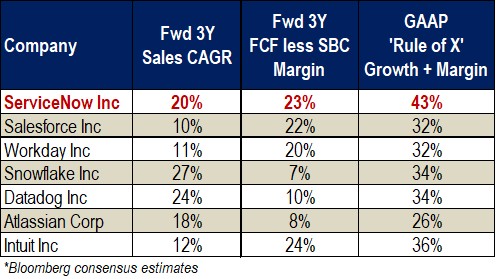
Management also targets a ‘rule of 50’ GAAP target by 2030 (sales growth + FCF margin less SBC). This implies a FCF less SBC margin of >30% in 2030. In 2025 the company achieved a margin of 15%.
The company currently ranks favourably versus peers in terms of GAAP ‘rule of X’ metrics using consensus forward estimates.
SHAREHOLDER ALIGNMENT
Management Signals
Bill McDermott has been the CEO of ServiceNow since October 2019, after serving as co-CEO and CEO of SAP from 2010. The founder Fred Luddy stepped away some years ago.
In February 2026, several senior executives, including the CEO, CFO & Vice Chairman, cancelled their scheduled Rule 10b5-1 trading plans, effectively halting all their pre-planned stock sales. At the same time, CEO McDermott personally purchased $3m of company shares on the open market.
This co-ordinated pause in executive selling, paired with the CEO’s significant personal investment, serves as a powerful signal of internal confidence in the company’s valuation and long-term AI strategy.
Stock Based Compensation (‘SBC’)
Stock Based Compensation tends to be a distorting line item in the financial statements. It is included as an expense in the income statement under GAAP accounting rules but is excluded from the company’s non-GAAP calculation of free cash flow.
We view it as a real economic cost given any associated share issuance dilutes the existing shareholder base. We prefer businesses to actively engage in increasing our earnings per share on both the numerator and the denominator.
ServiceNow is currently using its strong cash generation to repurchase shares. Management expects it to be dilution net neutral in 2026.
This is good but not great. There is an opportunity cost in using free cash flow to repurchase shares and offset SBC-related equity dilution. Every dollar of cashflow spent on anti-dilutive buybacks is a dollar that cannot be used elsewhere:
- Returned directly to shareholders through dividends or larger net buybacks.
- Reinvested in high-ROIC growth opportunities.
- Used to strengthen the balance sheet.
- Deployed for strategic acquisitions.
Positively, management is actively working to reduce the company’s reliance on Stock-Based Compensation and has laid out clear long-term targets to bring it down significantly.
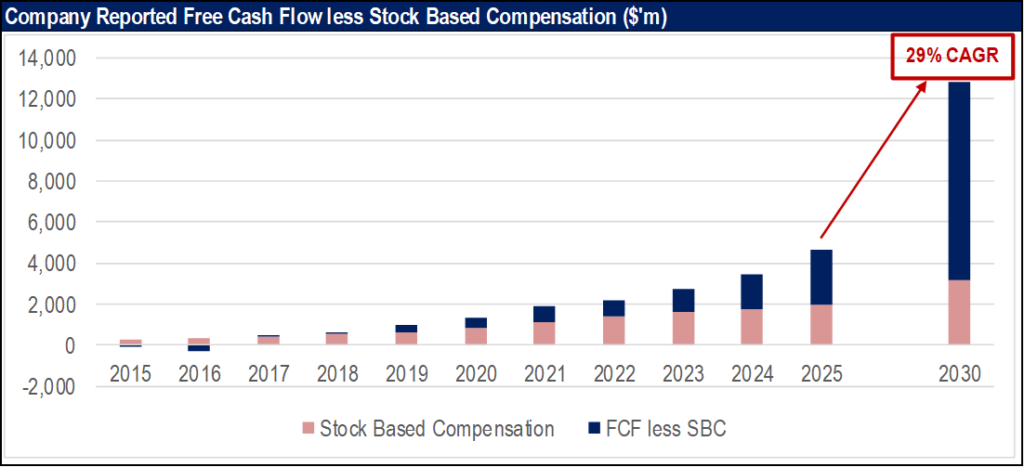
Management is targeting to reduce SBC to less than 10% of revenue by 2029. If it can achieve this goal in line with other targets, it will be producing approximately $9.6b free cash flow less SBC by 2030. A 3.5x increase from the $2.7b achieved in 2025.
CONCLUSION
The bear case for ServiceNow is not a single risk but a convergence of factors: platform disintermediation, seat model erosion, pricing volatility and unproven AI monetization.
The bull case runs counter to the market’s perception that AI will be damaging for ServiceNow. Instead of being disrupted, ServiceNow is uniquely positioned to emerge as a primary beneficiary and monetizer of enterprise agentic AI.
“ServiceNow is destined to be the best platform, the operating system of enterprise AI agents.” – Jensen Huang, CEO of Nvidia
ServiceNow’s core AI strategy of embedding intelligence into enterprise workflows has been in development since at least 2018. The current wave of AI investment represents an acceleration and expansion of that thesis, not a new direction.
[1] A token is roughly equivalent to a fractional compute cost (a few words or a specific action).
This document and all is contents remain the property of Middleton Enterprises Ltd and should not be copied or passed to any third party without prior permission. The contents of this document are for general information and use only and are not intended to address the particular investment or other requirements of any recipient. In particular, the information provided does not constitute any form of advice, representation or recommendation regarding any investments and does not constitute an offer to buy or sell the securities of any company. This document is confidential and is intended solely for the person or entity to which it was addressed. Further Middleton Enterprises Ltd does not warrant or guarantee the accuracy of the information provided and cannot be held responsible for any use of the document in whole or in part or the information it contains.